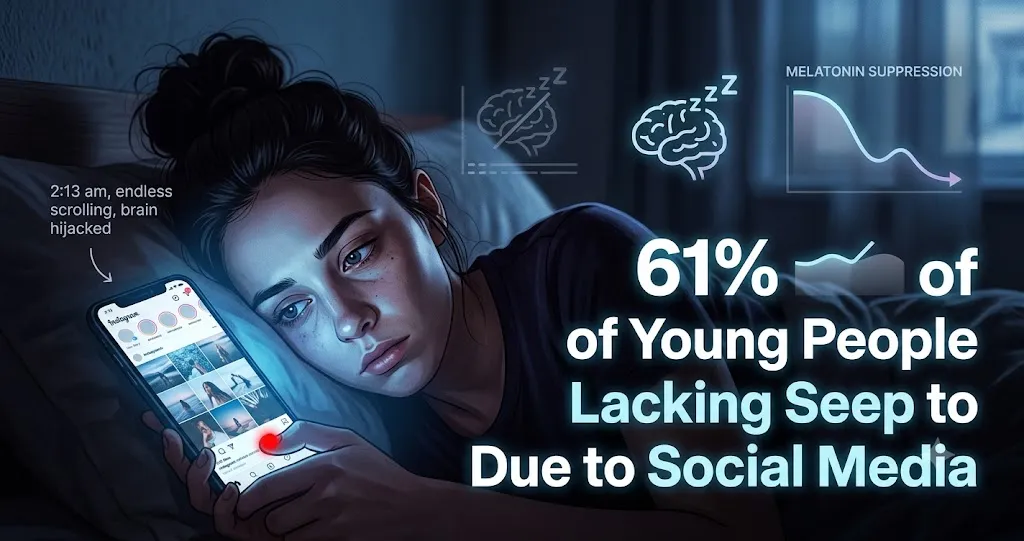
61% of People Are Losing Sleep Because of Social Media — And Your Brain Is Being Chemically Hijacked Every Night
Keywords: social media sleep problems, late night phone use anxiety
“At 2:13 am, Ellie turned off her phone after endlessly scrolling Instagram Reels. She would wake up tired, groggy, and mentally foggy — and she had no idea her phone was the reason why.”
Sound familiar? You’re not alone — and you’re not weak-willed. You’re neurologically outmatched.
The Numbers First — Because They’re Alarming
Before we get into the biology, let’s look at what the data actually says in 2025:
- 61% of teens wake up at least once during the night to check their phones
- 76% of US adults use social media within one hour of going to bed
- The average sleep duration for heavy nighttime scrollers has dropped to 6.1 hours — against the recommended 8
- People who scroll 90+ minutes after 9 pm are 2.8× more likely to report insomnia symptoms
- The average time to fall asleep for heavy social media users has risen to 42 minutes
- 28% of adults say their sleep quality worsens specifically after viewing emotionally charged content online
- 66.3% of university students report poor sleep quality overall
These aren’t soft, anecdotal numbers. They come from large-scale surveys, peer-reviewed studies across 40 countries, and research from institutions including the American Academy of Sleep Medicine and Scientific American.
The question isn’t whether social media disrupts sleep. It does. The question is exactly how — and what you can do about it tonight.
Mechanism #1: Blue Light Is Telling Your Brain It’s Noon
Your phone screen emits blue light in the 400–500nm wavelength range — the same spectrum as midday sunlight. And here’s the problem: your brain has no idea it’s midnight.
What happens biologically:
Your retinal ganglion cells — photoreceptors in the eye specifically wired to detect blue light — send a signal straight to the suprachiasmatic nucleus (SCN), the master clock of your brain. The SCN then tells your pineal gland to stop producing melatonin.
Melatonin is the hormone that makes you feel sleepy. It should peak naturally around 9–10 pm and stay high through the night.
Studies show melatonin suppression begins within 5 minutes of blue light exposure, and suppression can reach ~40% during continuous exposure. Meanwhile, cortisol levels — your stress and alertness hormone — also rise in response to light at night.
Real-world example: Priya, 26, scrolls Instagram in bed from 10:30–11:30 pm. By 11 pm, her melatonin is already suppressed by nearly half. She lies awake until 1 am wondering why she can’t sleep — completely unaware her phone rewired her chemistry an hour earlier. She wakes at 7 am for work on less than 6 hours of broken sleep, reaches for coffee immediately, and feels anxious by afternoon.
The fix: Stop all screen exposure at least 60 minutes before your target sleep time. If you must use screens, warm-mode (Night Shift / Night Mode) and blue-light blocking glasses reduce — but don’t eliminate — the effect.
Mechanism #2: It’s Not Just the Light — It’s What You’re Watching
Here’s what most people miss: a 2024 study of 830 young adults published and covered by Scientific American found something counterintuitive. Total screen time was not the strongest predictor of poor sleep. Emotional investment and frequency of checking were.
This means you could spend 2 hours watching a neutral documentary and sleep better than someone who spends 20 minutes reading angry comment threads.
The cortisol-anxiety spiral: When you encounter emotionally charged content — upsetting news, social comparison, conflict, political outrage — your brain triggers a stress response. Cortisol spikes. Your prefrontal cortex lights up with worry and problem-solving. This is called presleep cognitive arousal, and it’s one of the single strongest predictors of insomnia.
Platform-specific anxiety data from 2025:
- Facebook is the most anxiety-inducing platform: 21.5% of users report it
- TikTok follows at 12.8%
- Instagram at 9.7%
Real-world example: Rahul, 31, checks Twitter/X at 11 pm. He sees a news story that angers him. He spends 20 minutes reading comments. His cortisol spikes, his mind races. He puts his phone down at midnight — but his brain is still mentally arguing with strangers at 1 am. He falls asleep at 2 am, wakes groggy, and the cycle repeats.
The fix: The content matters as much as the clock. Avoid emotionally activating content in the 2 hours before bed — even if you’re watching it on a “safe” blue-light-filtered screen.
Mechanism #3: You’re Caught in a Dopamine Trap — By Design
Late-night scrolling isn’t a character flaw. It’s a product of billions of dollars of behavioural engineering.
Here’s the loop your brain gets stuck in, step by step:
Step 1: You feel tired, but reach for your phone “just for a minute.”
Step 2: Every scroll is a mini slot machine. Variable reward — sometimes boring content, sometimes something amazing — is the most addictive psychological mechanism known to behavioural science. Your brain anticipates the next dopamine hit.
Step 3: Cortisol + blue light suppress melatonin further. You actually feel less sleepy now.
Step 4: You’re wide awake at midnight. You scroll more to fill the time.
Step 5: You finally crash — but your sleep architecture is fragmented. You spend less time in deep slow-wave sleep and REM. You wake exhausted.
The algorithm doesn’t care about your circadian rhythm. It is literally optimised to maximise your time on the platform. Your tired, low-willpower, late-night brain is the easiest version of you to exploit.
The data backs this up: 82.7% of students in a 2025 University of Duhok study reported using social media specifically at bedtime. 43% of Gen Z adults lose sleep due to notifications alone.
The fix: Remove social apps from your phone’s home screen. Use a dedicated alarm clock instead of your phone. Charge your phone outside your bedroom — this single change has the highest evidence base for reducing nighttime use.
The 5-Step Wind-Down Routine (Starting Tonight)
This isn’t a vague wellness suggestion. Each step has a specific physiological reason behind it.
9:00 pm — Hard phone cut-off
Set a non-negotiable phone alarm labeled “sleep protection.” Put it on Do Not Disturb and place it in another room.
Why: Melatonin production needs ~60 minutes of darkness to begin rising again after blue light exposure ends. Give it the runway it needs.
9:10 pm — Dim your lights
Switch to warm-temperature bulbs (under 2700K) or use lamps instead of overhead lighting. If you use screens in the evening, switch on Night Mode.
Why: Overhead white LED lighting also suppresses melatonin. The environment matters, not just your phone.
9:20 pm — Cortisol dump — write it out
Spend 5 minutes writing your 3 biggest worries or tasks for tomorrow. Close the notebook.
Why: Journaling offloads “open loops” from your working memory. Research shows this quiets the prefrontal cortex — the part of the brain running the anxious commentary that keeps you awake.
9:30 pm — Body temperature drop
Take a warm shower. This seems counterintuitive, but a warm shower raises your skin temperature and triggers heat dissipation — your core body temperature drops afterward, mimicking the physiological state your body enters at sleep onset.
Alternatively: sip warm chamomile tea or magnesium glycinate. In 2025, 19% of US adults reported using magnesium for sleep (up from 9% in 2024).
9:45 pm — Analog wind-down
Read a physical book. Do light stretching or yoga. Listen to a low-stimulation podcast (nature, history, fiction — not news or commentary).
Why: Your nervous system needs a transition signal — a clear “the day is done” cue. Analog activities carry none of the variable-reward psychology of social media.
The Bottom Line
Social media sleep problems are biological, not moral. You’re not lazy. You’re not addicted to your phone because you lack discipline. You’re fighting neurochemistry shaped by billions of dollars of product engineering.
The good news: the biology also tells us exactly how to fix it. Remove the blue light trigger. Deprive the loop of its reward. Give your cortisol a release valve. Cool your body down. And make the last hour of your day boring — gloriously, restoratively boring.
Your sleep is your most underrated performance multiplier. It affects your mood, memory, immune system, cardiovascular health, and decision-making more than almost any other factor.
Protect it like the asset it is.
Share This
Save this post. Share it with someone you know who scrolls in bed.
Tag them and ask: “What time did you put your phone down last night?”
Sources & Further Reading
- SQ Magazine: How Does Social Media Affect Sleep Statistics 2025 (sqmagazine.co.uk)
- Scientific American / The Conversation: Why Social Media Screen Time Is So Bad for Sleep (2025)
- University of Duhok / Springer: Association Between Social Media and Sleep Quality Among University Students (2025)
- Khan et al., Journal of Adolescence: Intense and Problematic Social Media Use and Sleep Difficulties of Adolescents in 40 Countries (2024)
- Chronobiology Medicine: Impacts of Blue Light Exposure from Electronic Devices on Circadian Rhythm (2024)
- Frontiers in Neurology: Efficacy of Blue-Light Blocking Glasses — Systematic Review and Meta-Analysis (2025)
- NIH / Figueiro & Rea: Effects of Red and Blue Lights on Circadian Variations in Cortisol, Alpha Amylase, and Melatonin
- American Academy of Sleep Medicine: Scrolling for Sleep — Social Media Trends Impacting Americans’ Sleep Habits (2025)
#SleepHealth #SocialMediaSleepProblems #LateNightPhoneUseAnxiety #BlueLight #SleepScience #WindDownRoutine #DigitalWellness #SleepTips

Comments (0)
Leave a Comment
Your email address will not be published. Required fields are marked *